

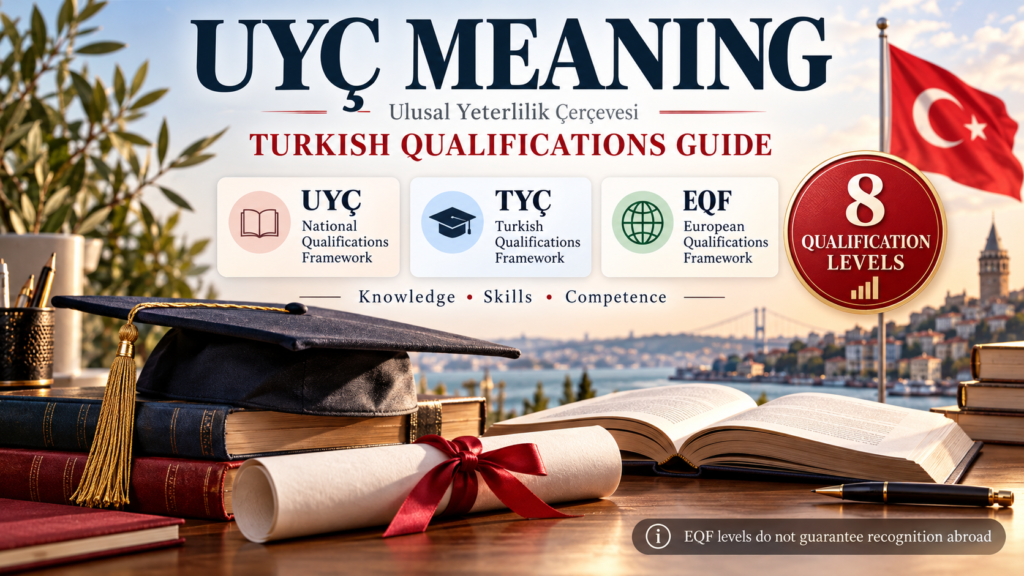
Uyç has a documented meaning in Turkish education. Written as UYÇ, it stands for Ulusal Yeterlilik Çerçevesi, or National Qualifications Framework. This general term describes a structure for classifying and comparing qualifications. Turkey’s specific national framework is called Türkiye Yeterlilikler Çerçevesi, abbreviated TYÇ.
Understanding these terms helps when researching diplomas, vocational certificates, and qualification levels. This guide explains Turkey’s eight qualification levels, the learning outcomes behind them, and their relationship with the European Qualifications Framework. It also covers how to check official qualification records and why comparing levels does not automatically settle questions about recognition abroad.
What Does Uyç Mean?
In Turkish education and vocational qualification documents, UYÇ stands for Ulusal Yeterlilik Çerçevesi, meaning National Qualifications Framework. Mesleki Yeterlilik Kurumu (MYK), Turkey’s Vocational Qualifications Authority, describes it as a set of principles and rules for defining qualifications, classifying them according to established criteria, and comparing them through levels. This framework helps connect different parts of a country’s qualification system.
Its purpose is to make qualifications more transparent and easier to understand while improving coordination between education and training routes. For example, a learner researching a certificate can use its framework level to understand where it sits within the wider system. MYK also explains that national qualifications frameworks support movement between qualifications, including progression to higher levels and movement between different learning pathways.
UYÇ and TYÇ: How the Terms Differ
UYÇ names a general framework concept, while TYÇ identifies Turkey’s specific national framework. The distinction comes from their full Turkish names: ulusal means national, and Türkiye identifies the country. MYK uses both terms when explaining how qualifications are organized.
| Abbreviation | Full Turkish Name | English Meaning |
|---|---|---|
| UYÇ | Ulusal Yeterlilik Çerçevesi | National Qualifications Framework |
| TYÇ | Türkiye Yeterlilikler Çerçevesi | Turkish Qualifications Framework |
TYÇ is therefore Turkey’s version of a UYÇ. MYK describes it as covering qualifications from general, vocational, and academic education, alongside other learning routes. It was designed to align with the European Qualifications Framework, helping make qualification levels easier to understand and compare internationally.
Official English-language publications also use TQF, short for Turkish Qualifications Framework. You may therefore encounter TYÇ in Turkish sources and TQF in English sources referring to the same national framework. Recognizing these labels makes it easier to follow information across both languages.
Uyç, UYÇ, and UYC: Spelling and Context
Uyç and UYÇ contain the same letters with different capitalization. UYC changes the final letter by replacing ç with c. The Turkish Language Association lists c and ç as separate letters, so removing the cedilla changes the spelling. This distinction matters when copying or searching for Turkish terminology.
In qualification documents, follow MYK’s spelling, UYÇ, and look for references to qualifications, levels, or TYÇ to establish the context. Capitalization alone cannot confirm the intended meaning. If similar letters appear in a username or an isolated message, check the surrounding text before connecting them with the qualifications framework.
Turkey’s Eight Qualification Levels
Turkey’s TYÇ framework has eight levels, numbered from 1 to 8. They describe learning outcomes with increasing complexity, responsibility, and independence. Each level considers knowledge, skills, and competence. The table below summarizes the official descriptors in plain English.
| Level | General Focus |
|---|---|
| 1 | General awareness and basic skills for carrying out simple tasks under guidance and supervision. |
| 2 | Elementary factual knowledge and simple problem solving, with supervision and limited independence. |
| 3 | Foundational theoretical and factual knowledge, taking responsibility for tasks, and adapting to changing situations. |
| 4 | Broader operational knowledge, solving problems within a field, and supervising others’ routine tasks. |
| 5 | Comprehensive knowledge, creative solutions, and management or supervision in situations involving unpredictable changes. |
| 6 | Advanced knowledge and skills for complex problems, professional activities, and decisions involving responsibility. |
| 7 | Advanced specialist knowledge, research and innovation skills, and managing complex situations requiring strategic approaches. |
| 8 | Knowledge at the forefront of a field, original research or innovation, and substantial professional independence. |
Higher education provides familiar examples: associate degrees sit at Level 5, bachelor’s degrees at Level 6, master’s degrees at Level 7, and doctoral qualifications at Level 8. High school diplomas are a qualification type at Level 4.
Several qualifications can share a level while differing in their purpose, learning outcomes, or workload. For example, a Level 5 associate degree and a Level 5 vocational qualification certificate remain distinct qualification types. Their shared level helps comparison, while the full qualification descriptions explain their individual content and uses.
Knowledge, Skills, and Competence: What Levels Describe
TYÇ describes qualifications through learning outcomes. These express what a learner is expected to know and be able to do. They are grouped into three connected areas that explain both the content of learning and how someone applies it.
| Area | What It Describes |
|---|---|
| Knowledge | Understanding facts, principles, theories, and practices relevant to a field of work or study. |
| Skills | Applying knowledge and using methods, tools, reasoning, or practical abilities to complete tasks and solve problems. |
| Competence | Using knowledge and skills with appropriate responsibility and independence, while addressing learning needs and social or ethical responsibilities. |
Consider a hypothetical technical task. Understanding the principles behind a procedure demonstrates knowledge, while performing it correctly demonstrates skill. Taking responsibility for the result and recognizing when help or further learning is needed demonstrate competence. The expected depth of each area depends on the qualification’s level, with higher levels involving more demanding knowledge, problems, and responsibilities.
Diplomas, Degrees, and Vocational Certificates
TYÇ includes quality-assured qualifications from general education, higher education, and vocational learning. School diplomas document completion of school programmes, including general and vocational routes. University qualifications include associate, bachelor’s, master’s, and doctoral degrees, with different learning outcomes and academic or professional purposes.
Vocational qualification certificates focus on occupational knowledge, skills, and competence. Within MYK’s system, authorized certification bodies assess candidates against the requirements of the relevant national qualification. This process can recognize skills gained through work experience as well as education or training, provided the candidate meets the assessment requirements.
Each qualification’s description explains its learning outcomes, assessment conditions, and the award successful candidates receive. These details help readers understand what a particular diploma, degree, or certificate represents. Formal inclusion in TYÇ also requires the qualification to meet the framework’s quality assurance conditions, including valid assessment and transparent certification processes.
MYK and the Authorities Behind the Framework
MYK, officially Mesleki Yeterlilik Kurumu, is Turkey’s Vocational Qualifications Authority. It coordinates and maintains TYÇ in cooperation with the Ministry of National Education and the Council of Higher Education. Each organization has responsibilities for qualifications within its own remit.
The ministry oversees qualifications across school education, vocational education, and relevant lifelong learning programmes. The Council of Higher Education coordinates and supervises qualifications awarded by higher education institutions. MYK’s responsibilities include national occupational standards, vocational qualifications, and oversight of authorized certification bodies.
The TQF Coordination Council and TQF Council provide decision-making and technical structures, supported by MYK’s secretariat. The Coordination Council approves key proposals, while the TQF Council develops procedures and criteria for implementation. Quality assurance remains a shared responsibility, with the relevant authority overseeing qualifications in its area.
TYÇ, EQF, and Recognition Abroad
TYÇ connects with the European Qualifications Framework (EQF) through a process called referencing. Cedefop reports that Turkey first referenced its framework to the EQF in 2017 and updated that referencing in March 2025. This establishes a relationship between Turkish qualification levels and the EQF’s eight levels.
The EQF helps translate qualification levels between participating countries, making learning outcomes easier to compare. Formal recognition remains a separate process, and a matching level alone does not guarantee university admission or permission to practise a regulated profession. Recognition depends on the applicable procedures and the purpose for which the qualification will be used.
Recognition for further study and recognition for professional work can follow different procedures. For study, check with the receiving institution and, where relevant, the destination country’s ENIC-NARIC centre. For a regulated profession, consult the responsible professional authority. Diploma Supplements and Certificate Supplements can help explain an award’s content and purpose during these processes, providing information beyond its framework level. About celebrity AllTimeMagazine.
How Students and Employers Use Qualification Levels
Students can use a qualification’s TYÇ level to understand its position in the national system and compare possible study routes. Reviewing its learning outcomes, qualification type, and progression information helps them explore options for further learning. Guidance advisers can use these details when discussing academic, vocational, or experience-based pathways and identifying where additional learning may be useful.
Employers can use TYÇ and EQF levels to interpret unfamiliar qualifications and understand how advanced their learning outcomes are. Comparing those outcomes with the knowledge and skills required for a role can support recruitment and staff development. Applicants can make this comparison easier by presenting the full qualification title, awarding institution, and verified level together. Qualification records and supporting supplements provide further detail when an employer needs to assess the award’s content more closely.
How to Check Official Qualification Records
Use the Türkiye Qualifications Database to locate the relevant diploma, degree, or vocational qualification. Search by qualification title or code, then narrow results by institution, level, qualification type, or TYÇ placement status.
- Match the qualification. Confirm the award’s full title, qualification code, and responsible institution.
- Read the details. Review learning outcomes, assessment conditions, and any stated TYÇ and EQF levels.
- Confirm formal placement. Check the explicit TYÇ inclusion status and placement date, where available.
- Use supporting QR codes. If a diploma or certificate carries a TYÇ logo with a QR code, scan it to reach the corresponding qualification record.
Cedefop distinguishes publication in the database from formal inclusion in TYÇ. If placement information is unclear, ask the responsible institution or MYK to confirm it. This helps ensure that any level or inclusion claim you quote is supported by the official record.
Frequently Asked Questions
What does uyç mean in English?
In Turkish qualification terminology, UYÇ stands for Ulusal Yeterlilik Çerçevesi, meaning National Qualifications Framework. Its meaning in other settings depends on the surrounding context.
Is UYÇ the same as TYÇ?
UYÇ is the general term for a national qualifications framework. TYÇ, short for Türkiye Yeterlilikler Çerçevesi, identifies Turkey’s specific national framework.
Are uyç and UYC the same abbreviation?
They are different written forms. Turkish c and ç are separate letters, so check the source and context before assuming that uyç and UYC represent the same abbreviation.
How many levels does Turkey’s qualifications framework have?
TYÇ has eight levels, numbered from 1 to 8. They describe learning outcomes in knowledge, skills, and competence, with increasing complexity and responsibility.
Does an EQF level guarantee recognition abroad?
No. An EQF level supports comparison between qualifications. Recognition for further study or regulated professional work follows the applicable procedures in the destination country.
Where can you check a Turkish qualification?
Use the Türkiye Qualifications Database to search by qualification title or code. Review the responsible institution, learning outcomes, levels, and explicit TYÇ inclusion status, since database publication and formal framework inclusion are separate.
Conclusion: Understanding Uyç and Qualification Levels
Understanding uyç starts with its Turkish qualification context and the distinction between the general UYÇ concept and Turkey’s TYÇ framework. TYÇ’s eight levels provide a shared language for describing learning outcomes across education and vocational qualifications.
For a useful comparison, connect the level with the award’s content, qualification type, responsible institution, and confirmed inclusion status. Official records help establish these details, while recognition abroad follows the relevant academic or professional procedures. Reading these elements together gives students and employers a clearer understanding of what a qualification represents.
